Since getting a smart trainer I have found myself hopelessly addicted to power numbers. Training with a smart trainer is a great way to build focused work outs and measure your progress (or lack thereof). The issue then is what do all these “watts” mean when you are out cycling in the real world? Strava will do a little estimation for you but how accurate is that really?
So I found myself tempted into investing in a power meter but just what to go for?
Cutting to the chase you will see I ended up with a pair of Garmin Vector 3 pedals but it was not a straightforward choice.
One clear factor was price. Crank or spider type power meters tend to be more expensive but at the lower end can be had for similar money as power meter pedals. However there are additional costs for new chainrings and the nightmare of bottom bracket compatibility threatened to make my head hurt.
I was, and still am, concerned over the longevity of power meter pedals, they are in the front line of the muck and debris that the road throws up. I my experience pedals have a limited life span.
In the end the factors that won it for me were price, ease of set up and portability between bikes.
So then the only remaining issue was which make. I already have a number of Garmin devices so they were the natural choice. The Vector 3’s look almost like normal pedals, not having the pods that the Favero Assioma pedals have. The Garmin pedals have had some reliability issues in the past but I figured that these were sorted by now as the forums had gone quiet.
Overall Design
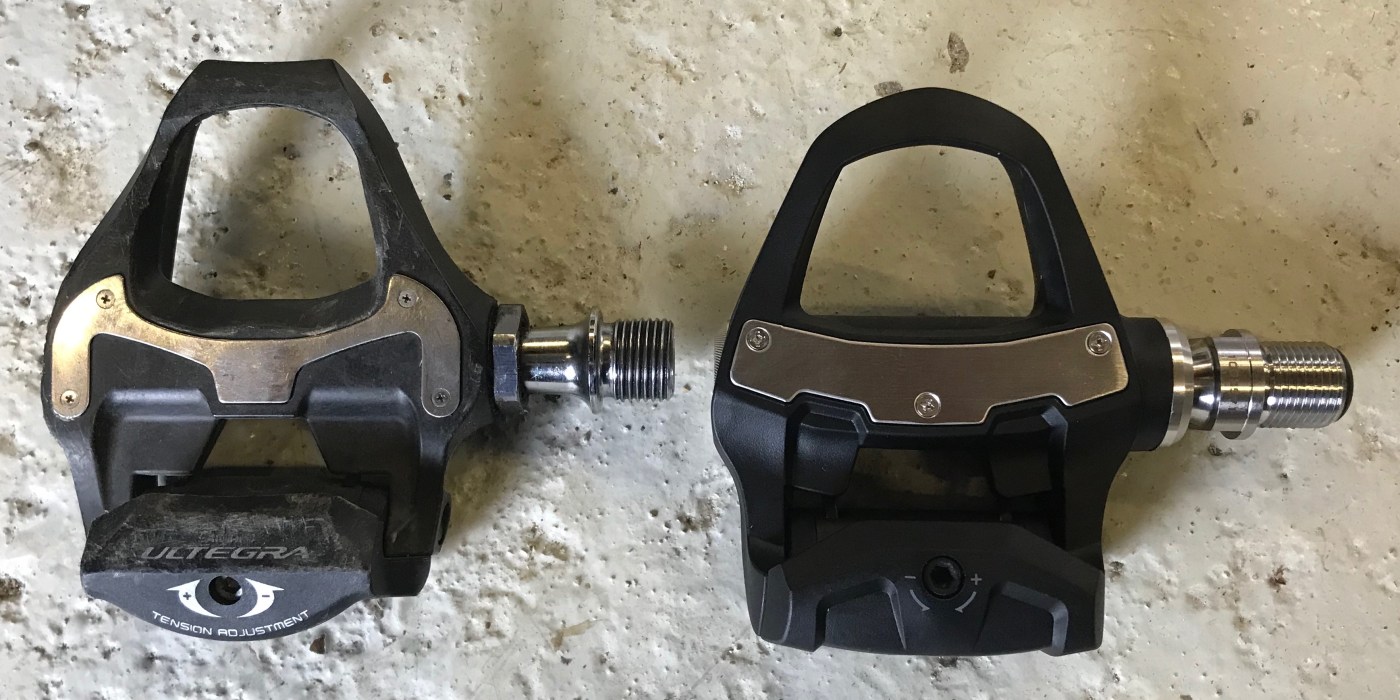
After a pair of Look pedals fell to pieces on me after about a year of use I swapped to Shimano’s Ultegra pedals. To my eyes they appear better made than the Looks and have lasted much longer. In fact they are still going strong two years later, the bearings run smooth with no play and they have yet to be serviced. The Vectors have that same feel about them (though time will tell) and have a very similar design.


The Vector pedals use Look cleats, which are not as broad as the Shimano cleats so they are less stable to walk in. However the Vector pedals themselves have a very wide platform, very similar to the Ultegra pedals meaning you have a very stable platform to pedal against and it that key aspect I cannot split the two.
Weight
As you will see from the photos below the Vectors compare quite favourably to my Ultegra pedals. At 160g vs 130g the Vectors are only 30g per pedal heavier. It is an insignificant weight penalty in reality, about the same as a typical energy bar.


Installation
If you have got used to installing pedals with a large Allen key (or hex wrench if you must) then you will have to dig out your old pedal spanner. The socket you find on the end of an Ultegra pedal spindle is used to house the indicator lights on the Vector 3’s
Otherwise they are again very similar to the Ultegra pedals. The distance from the centre of the pedal to the shoulder on the spindle is about 53mm on both so the spacing of your foot should be unaffected.


You will however note that the threaded part of the vector spindle is significantly longer. A small portion of the spindle does protrude past the end of the crank arms. In my case there is no danger of this clashing with the chain stays, however Garmin do supply 2 spacer washers to slip over the spindles to bring the ends flush if needed.


Use
It is great to have live power data during a ride, knowing what numbers you can put out on a smart trainer means that straight away you can pace yourself more effectively out on the road and measure the effort you are actually putting in. This is really what I use the power numbers for.
Garmin head units churn out a host of “cycling dynamics” data which is interesting to view but at my level not something that is going to change my approach to riding.
The newer Garmin head units also use the power numbers to generate a chunk of training performance data. This something I want to understand more about but on first pass looks similar to the training effect data that something like Training Peaks generates, though obviously not as comprehensive.
Conclusions
It was an easy and painless change from Ultegra to Vector 3 pedals. The data junkie in me is constantly mesmerised by all of the information that Garmin generates but all I am really only using the watts. To that end the Vectors have been an expensive upgrade and one which for me is definitely a ‘nice to have’. I could easily live without them and on the ‘value for money’ stakes these clearly sit at the bottom of the table. If I put some effort into understanding and acting on all of the various metrics they produce the ‘VFM” index may improve but I doubt they will ever move from last place.
 rideupgrades
Value for money is a subjective thing I guess. I love riding with power on the road. It’s interesting and helps (sometimes) with pacing. I’m no racer. They’re not going to make me faster, but I find the numbers fun to look over and I missed them the one time I ran the battery flat! So although they’re about as expensive as pedals get, I rate them as good value for money. 🙂
LikeLiked by 1 person